


Please feel free to read our client newsletter. It is provided to keep you up to date on the latest tax and accounting news.
Tax rules aren’t set in stone...what worked last year might not work this year. If you're not keeping your tax strategy up-to-date, you could be inviting a bigger bill from the IRS. In this month’s issue, we’re breaking down practical tax tips to help you stay ahead and keep more of what you earn.
Also learn how to lower your property tax bill, financial tips that sound like common sense, and how to graduate with zero student loan debt.
As always, should you have any questions, please call. And feel free to forward this information to someone who could use it!
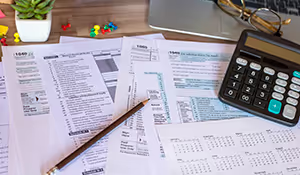
The U.S. tax code is constantly changing. What saved you money last year might cost you this year. Between shifting income thresholds, changing deduction rules, and overlooked credits, you now need to stay focused on your tax plan throughout the year. Here are several bits of tax wisdom that can help you lower your bill to the IRS.
Phaseouts matter (a lot). A lot of tax breaks, such as child tax credits, tax benefits for college costs, or the new senior deduction don't disappear all at once. Instead, they phase out slowly as your income rises. This means earning a bit more could quietly cost you some of these benefits.
What you can do: Keep an eye on how much income you’re showing on paper and how it will impact these phaseouts. You might be able to stay in the sweet spot so you don’t lose the value of your deductions or credits by putting more into your retirement account or timing when you receive certain payments.
Are itemized deductions going the way of the dinosaur? Not so fast! Yes, the standard deduction is now higher than ever ($31,500 for married couples, $15,750 for singles in 2025), which has made itemizing less common. But with an increase of the state and local tax (SALT) deduction from $10,000 to $40,000, you may be shifting back to itemizing your deductions without realizing it.
What you can do: Don’t assume you'll be taking the standard deduction again this year. Add up your potential itemized deductions, especially if your expenses vary, to see how close you are to being able to itemize. Consider bunching charitable contributions or property taxes into one year to clear the standard deduction hurdle.
Timing is everything (especially with capital gains). If you sell assets held longer than a year, you’ll likely qualify for long-term capital gains rates (0%, 15%, or 20%). But miss that time by even a day and you could pay ordinary income rates, which can be nearly double. Strategic timing can also help you harvest losses to offset gains and reduce your overall tax bill.
What you can do: If possible, hold investments that are profitable for at least one year and a day before selling to qualify for lower tax rates. Use end-of-year tax-loss harvesting to offset gains, and stagger sales across tax years if needed.
Don't sleep on the Qualified Business Income deduction. If you're a small business owner, self-employed, or even a gig worker, you may be eligible for a 20% deduction on your qualified business income. Planning how and when revenue hits your books could make or break your eligibility for this significant deduction.
What you can do: Review how your business is structured and how much income you're reporting. You may be able to reduce taxable income through retirement contributions, shifting income between years, or reclassifying your business activities.
Tax-deferred doesn't mean tax-free. Traditional 401(k)s and IRAs offer tax deferral, not tax elimination. When you withdraw funds in retirement, you’ll pay ordinary income tax on the distributions. If you expect to be in a high tax bracket in retirement, it may be a better idea to contribute to a Roth account now and pay taxes up front.
What you can do: Schedule a planning session to discuss whether diversifying your retirement accounts between traditional and Roth makes sense for your situation. Also consider planning for the timing of distributions from these accounts to be as tax efficient as possible. Run long-term tax projections to decide which type of contribution makes sense today. Consider partial Roth conversions during lower-income years.
Tax planning isn't a once-a-year scramble, but rather a year-round strategy. And with these pieces of prevailing tax wisdom, you can be better prepared to cut your tax bill. Please call if you have any questions about your tax situation.
Property taxes are still on the upswing in many parts of the U.S. To help get a handle on your property taxes, here’s a look at what goes into determining your bill and a few ideas that may help to reduce it.
Property taxes are typically calculated using two factors:

Why this matters: Even if your home’s value doesn’t change, your tax bill can go up if any of the taxing authorities raise their rates. And while setting the tax rates is usually a legislative process, establishing the value of your property often has judgement applied.
Property taxes are one of the few taxes you can actually fight and get lowered. But you can’t do that if you don’t understand how the system works. So don’t just pay the bill without looking at it. There’s often money to be saved if you understand the details.
A growing number of students are saying no to paying for higher education with student loans. Here’s how to join the growing number of students graduating debt-free, often by using unconventional approaches.

While student loans remain the norm for many, the rise of debt-free graduates shows that alternatives do exist. These paths may be unconventional, but they show that a college degree or technical certification doesn’t have to mean decades of repayment.

In a time when information is always at our fingertips and digital tools dominate daily life, there’s something quietly appealing about picking up a pencil, winding a watch, or playing a record.
Here's what appears to be driving the trend to operate without screens or batteries.
Technology has continually moved us towards digital precision. Photos can be edited until flawless, music can be perfectly tuned, and every word can be polished by spell-check. But sometimes, that perfection feels a little flat.
Analog technology brings back what modern tools often smooth away: small imperfections. The soft crackle of a vinyl record adds character to the music. A Polaroid’s uneven exposure becomes part of its charm. A typewritten page might have a slightly tilted e, but it reflects the hand of the person who made it.
In a world filled with polished, curated images, the imperfections of analog offer a feeling of authenticity.
Need a song? Stream it instantly. Want to send a message? Sent to the other side of our planet in 0.3 seconds. But speed has a catch: it flattens experiences.
Shooting film forces you to slow down. You don’t get 1,000 shots, you get 36 (if you’re lucky). Writing with a fountain pen is deliberate. Even making a mix tape on cassette – pausing, rewinding, recording in real time – demands a kind of presence that modern tech rarely asks of us.
Ironically, in a hyper-connected world, the true luxury is slowness. Analog tech is the ultimate status symbol because it’s proof you can take your time.
A file on your phone weighs nothing. It can vanish without warning, courtesy of a corrupted drive or forgotten cloud password.
Analog stuff on the other hand, such as records, notebooks, and physical photographs, have weight. They occupy space. They age, and in aging, they gain character. A dog-eared book isn’t just a copy...it’s your copy, with coffee stains from that trip you took in 2017 and the faint smell of sunscreen from the day you left it on the beach.
In a world of momentary pixels, analog gives us artifacts.
With all this in mind, here’s are some of the ways the analog revival can work in your favor:
Analog tech’s comeback isn’t about rejecting the future, it’s about rounding it out. It’s about reminding ourselves that life isn’t meant to be optimized in every way possible.

.svg)